

And as imagination bodies forth
The forms of things unknown, the poet's pen
Turns them to shapes and gives to airy nothing
A local habitation and a name.
The Shakespeare Birthplace Trust (SBT) has been awarded the status of an Independent Research Organisation (IRO).
This is UKRI’s formal recognition that an organisation has the expertise, governance and in-house capacity to lead research that strengthens the UK’s knowledge base. Granted following a rigorous assessment and authorisation process, IRO status places the SBT alongside universities and other leading research institutions within UKRI’s standard funding framework. The award is therefore both a significant endorsement of the Trust’s research excellence and a gateway to new funding, partnerships and ambitious research programmes.
As the only non-national and independent museum outside London, this recognition of a world-leading organisation is a testimony to the history and evolution of the Trust as a global centre for research and knowledge exchange. It is especially significant for Stratford-Upon-Avon, which now hosts two organisations with the status, The SBT and The Royal Shakespeare Company.
Rachael North, Chief Executive of the Shakespeare Birthplace Trust said “The Shakespeare Birthplace Trust has long been at the heart of a global conversation about the life, times and work of William Shakespeare. The award of IRO status enables us to build on this significant research legacy in ways which position scholarship at the core of our new 10-year strategy and ensures our nationally significant collections and the five Shakespeare family homes remain relevant and resonant for everyone.”
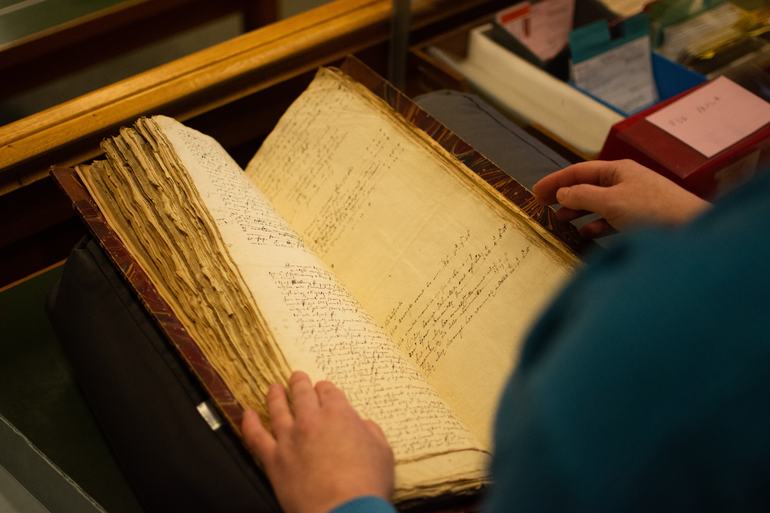
IRO status will enable the Shakespeare Birthplace Trust to substantially extend its existing research base and deliver its research objectives as a World Shakespeare Museum: broadening access to and engagement with research through the Shakespeare family homes, collections, exhibitions, loans, community projects and digital programming. It will support the Trust to create a research culture across all its programmes — from learning to exhibitions, curation and conservation — rooted in research and designed to develop deeper and richer engagement for and with audiences, both present and future.
Prof Charlotte Scott, Director of Shakespeare Scholarship at the Shakespeare Birthplace Trust added “This is a significant opportunity for the Trust to reflect on its legacy as well as its future. As the home of Shakespeare, we are committed to developing shared knowledge and research cultures that drive innovation towards a global ecology, underpinned by the preservation of the past to produce new futures.”
Sir Christopher Smith, Executive Chair AHRC, commented: “I am delighted to see the Shakespeare Birthplace Trust awarded Independent Research Organisation status. This recognition reflects the Trust's established research capabilities and the important contribution its collections, expertise and partnerships make to the UK's research and innovation landscape. We look forward to seeing how the remarkable concentration of creative industries in the Midlands, with CreatechFutures, LIPF funding and another brilliant IRO in the Royal Shakespeare Company, can develop new research and innovation opportunities.”
With IRO status, The Trust will produce, share and activate knowledge arising from its world-class collections, houses and unique sense of place, using them as a starting point for new, ambitious, intersectional and multi-disciplinary research projects. This work will include focusing on SBT’s core themes - biography and legacy, place and home - re-cataloguing, digitising and interpreting collections for wider access; researching Shakespeare’s life, Stratford-upon-Avon, his creative and global legacies, cultural capital and social mobility; and supporting research across conservation, collections care, pedagogy, dramaturgy, curatorial and interpretative practice, archival and library work.
This new IRO status creates unique opportunities for The Trust to build future partnerships, deepen the organisations research ecologies, create digital and audience focused pathways to become a truly sustainable and vision-led organization, or as Ophelia would acknowledge:
‘we know what we are but
know not what we may be’ (Hamlet, 4.5).
The Shakespeare Birthplace Trust was established in 1847, following a public campaign led by Charles Dickens to keep the building in Stratford-Upon-Avon for the people and by the people. Over the next century, the SBT acquired the four remaining properties that had belonged to the Shakespeare families, including Shakespeare’s New Place estate (1876); Anne Hathaway’s Cottage, the childhood home of his wife (1892); Mary Arden’s Farm, the childhood home of his mother (1930); and Hall’s Croft, the marital home of his daughter Susanna Hall (1949).
Following the acquisition of Shakespeare’s Birthplace and childhood home, the Trust began collecting records, documents, visual and decorative arts, and objects of association relating to Stratford, Shakespeare’s life, and his legacy. These include the performance archives of internationally renowned scenographers and artists. The Trust is the largest publicly library and archive on open access, with over 1 million items in our care.
The Trust is governed by two Acts of Parliament, 1891 and 1961, to promote the appreciation and advancement of Shakespeare knowledge worldwide and to maintain the museum and collections for the benefit of the nation. In 2014 the Trust’s Shakespeare documents were inscribed on the UNESCO UK Memory of the World Register.
The stewardship of the Shakespeare family homes and archives ‘for the people and by the people’ remains fundamental to the Trust’s vision, values and future which uphold the Shakespeare story, its origin and evolutions.
Find out more: www.shakespeare.org.uk
ENDS
For further information contact [email protected].