

“The most complete man of the theatre it has been my privilege to know” (Tom Fleming)
The theatre design archive of artist Abd’Elkader Farrah (1926–2005) - the Royal Shakespeare Company’s resident designer for three decades - is cared for by the Shakespeare Birthplace Trust in Stratford-upon-Avon and the Farrah family. The most complete surviving body of Farrah’s work, it is a remarkable and largely unexplored record of a designer whose ideas, from Shakespeare to Sophocles and Brecht, transformed theatre scenography in the twentieth century.
The Shakespeare Birthplace Trust is deeply proud to work with the Farrah family and to hold Farrah’s collection of designs, all the more unique for demonstrating the brilliance of a pioneering creativity.
The Trust has been awarded a highly competitive ‘Archives Revealed’ grant for £49,638 for Raising the Curtain: A First Reveal of Abd’Elkader Farrah’s Theatre Design Archive. Over the next year, Raising the Curtain will begin to unlock the archive through cataloguing, research and collaboration, making it accessible to the public and offering new perspectives on theatre and performance, as well as opportunities for research, learning and creative engagement.
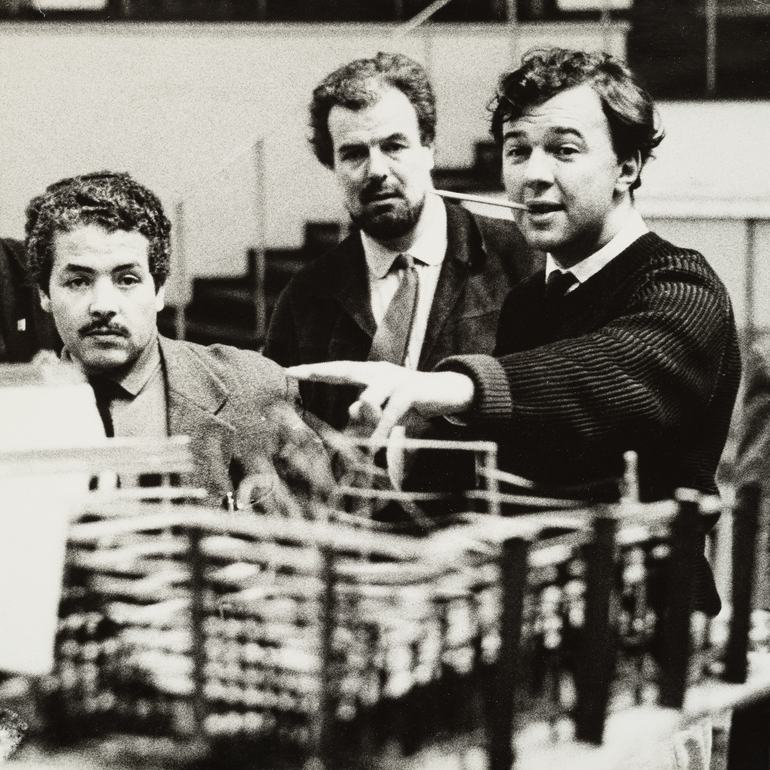
The Farrah Family commented: “Born into an eminent Algerian family, Farrah’s self-taught virtuosity launched him into the heady worlds of classical drama, ballet and opera in 1950s Europe, and from there to pioneering decades with the Royal Shakespeare Company and the international stage, with over 300 productions to his name. His extraordinary life experience intensified the unique impact of his vision, and enriched his later roles of tutor, mentor and author. We look forward to witnessing the celebration of that legacy, under the aegis of the Shakespeare Birthplace Trust.”
At first glance you might be forgiven for thinking Tom Fleming’s description refers to William Shakespeare, perhaps even conflating it with Ben Jonson's famous accolade that he was 'not for an age but for all time". In fact, this refers – in the words of fellow designer John Napier - to the 'wisest’ and most influential stage designer of the twentieth century: Abd’Elkader Farrah.
Farrah changed the world of scenography. Working with some of the most renowned directors and actors who have shaped our perception of Shakespeare, he understood the power of vision, detail and instantaneous impact in the creation of worlds onstage. His craft was that of artist, thinker, audience member and creative.
For Farrah, theatre shaped how you understood the world, and this was never homogenous or linear but about experiencing feeling through a multi-sensory pathway to emotion.
The coup de théâtre as – ablaze with heraldic emblems - the Henry V canopy unfurls, filling the Stratford stage…the exquisite and disturbing chaos of Marlowe's Dr Faustus… the fragility and verdant magic of the pagan world in As You Like It… and the devastating power of Oedipus Rex. These memorable fragments reveal Farrah's vision of what it means to encounter theatre, to imbibe stories and to emerge affected from the whole.
Reflecting on the 1960 Sadlers Wells production of Oedipus Rex, award-winning film-maker Tony Palmer, commented recently “…directed by Michel St Denis, designed by Farrah and conducted by a very young Colin Davis, I remember it as if it were yesterday, so powerful an impression did it make. I happen also to know that Stravinsky himself thought this was the definitive production of his opera/oratorio in that it finally persuaded him that his work had a life on the stage as opposed to merely in the concert hall”.
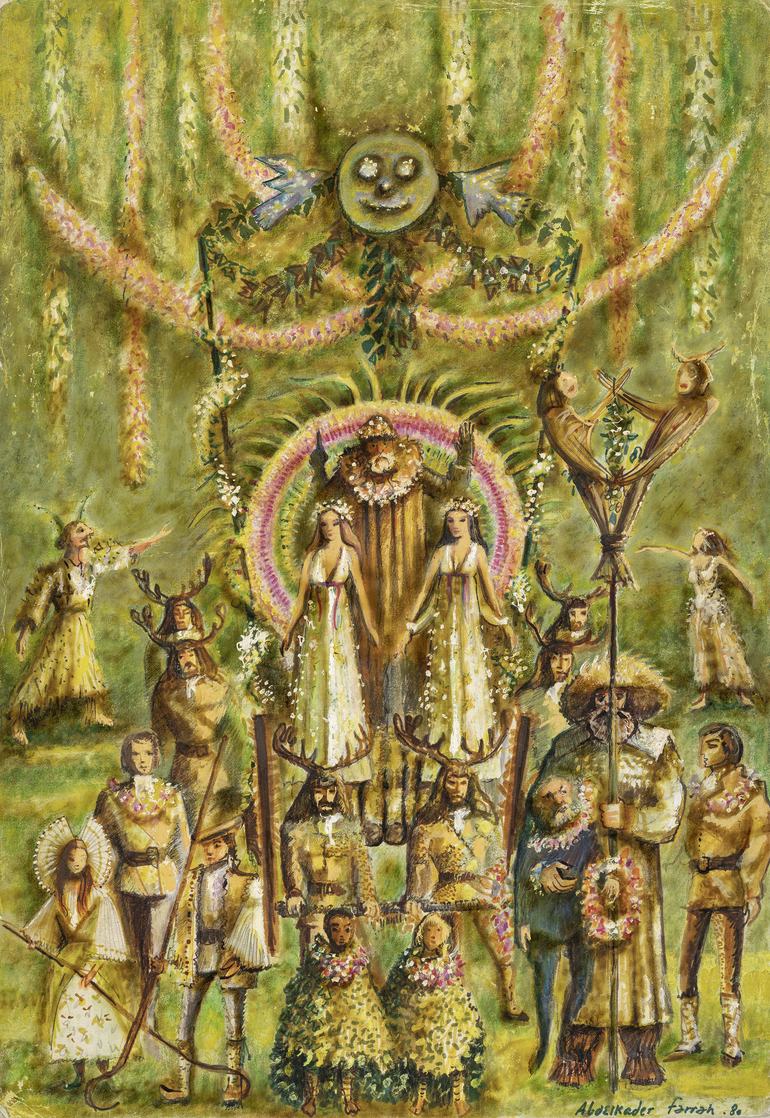
According to Dr Dominique Bouchard, Creative Director of the Shakespeare Birthplace Trust, “The opportunity to open up the Farrah Archive in Stratford-upon-Avon is a significant contribution to Stratford’s heritage and to the Shakespeare Birthplace Trust’s remarkable research collections. The Farrah Archive helps us encounter how Shakespeare’s legacy has been imagined, designed and re-made for the stage through Farrah’s vibrant and inspiring body of work, and it invites researchers, artists, students and audiences to connect his extraordinary contribution to the continuing life of Shakespeare today.”
Director of Shakespeare Scholarship at the Shakespeare Birthplace Trust, Prof Charlotte Scott commented: ‘Farrah’s impact on Shakespeare in performance is unrivalled, and, as custodians of Shakespeare’s life and legacy, it is an enormous privilege to be able to begin to unlock this precious archive and delve deeper into the artistic brilliance of Farrah’s work’.
From Sophocles to Chekhov, via Shakespeare and Mozart, Farrah's art shone a light on how we experience momentous stories. Farrah entered the world of theatre through the complementarity of East and West to both respect and reject traditional theatre, compelled by what he described as ‘the slow exploration process when and if allowed by time, finances, and belief” from the “rigour and ritual on a “bare stage” to the ‘disintegration of traditional space by mixing audience and action.’
Speaking of the art of scenography in 1983, Farrah observed:
‘To some, it becomes a revelation, to others it is a rediscovery – I respect a designer who can achieve the right metaphor about a piece.
The needs create the means. The design alphabet is impressive, bearing in mind stylistic suitability and economics; scenic painting; hard, soft, or pneumatic architecture; timber; textiles; metals; plastics; reflective surfaces; engineering, allowing dynamics of all kinds; lights, projections, laser and audiovisual technology… without forgetting the body and voice of the performer.’
This unprecedented approach is beautifully calibrated and revealed in the scope and breadth of the Farrah Archive. With the generous support of the Archives Revealed programme, funded by The National Lottery Heritage Fund, the Pilgrim Trust, the Wolfson Foundation and The National Archives, we can now catalogue and make available to the public an outstanding resource for future generations of international theatre makers, artists, actors, scholars and students.
This is a unique collection, and one which evidences what Shakespeare himself might call ‘a fine frenzy…from heaven to earth, earth to heaven, and as imagination bodies forth the forms of things unknown… turns them to shapes, and gives to airy nothing a local habitation and a name’.
ENDS
For more information, contact the Shakespeare Birthplace Trust: [email protected]
About the Archives Revealed programme
Archives Revealed is the only grant programme in the United Kingdom dedicated to cataloguing and unlocking archival collections. The programme is funded by The National Lottery Heritage Fund, the Pilgrim Trust, the Wolfson Foundation and The National Archives. Its goal is to ensure that significant archive collections—representing the lives and perspectives of people across the UK—are made accessible for public research and enjoyment.